


The serene fusion taking the design world by storm — and showing no signs of slowing down.
What Is Japandi Style?
Japandi is the harmonious marriage of Japanese and Scandinavian interior design philosophies. It takes the zen-like tranquility, wabi-sabi imperfection, and minimalist precision of Japanese design and blends it with the hygge warmth, cozy textures, and functional simplicity of Scandinavian style. The result? Spaces that feel simultaneously calm and inviting, minimal but never cold.
In a world overwhelmed by visual noise, the Japandi kitchen is a sanctuary — a place where every material is intentional, every line is purposeful, and every element earns its place. Searches for Japandi style have surged in recent years, and it’s easy to see why.
Here are 9 stunning Japandi kitchen examples to inspire your next renovation.
1. 🌿 The Glaven — Warm Oak Meets Concrete Serenity

The Glaven Kitchen by Naked Kitchens is a textbook example of Japandi balance. Brushed limed oak cabinetry sits beside crisp white panels, while Caesarstone concrete worktops bring an earthy, raw texture to the space. The darker wall shade adds depth without overwhelming, and the white paneled splashback injects just enough texture to keep things visually interesting. This is Japandi at its most composed — two contrasting forces creating one unified calm.
Key Design Elements:
- Warm brushed limed oak cabinetry
- Caesarstone concrete worktops
- White paneled splashback for subtle texture
- Muted, contrasting wall tone for depth
2. 🪵 The Brancaster Marshes — Light, Air & Natural Oak

The Brancaster Marshes Kitchen by Naked Kitchens is a masterclass in light and space. With clean lines, handleless J-Groove drawers in natural oak, and antique mirrored splashbacks, this kitchen maximizes natural daylight at every turn. The hidden storage keeps the surfaces immaculately uncluttered — a hallmark of true Japandi philosophy. This design feels like breathing deeply in a forest clearing.
Key Design Elements:
- Handleless J-Groove drawers in natural oak
- Antique mirrored splashback to amplify daylight
- Zero-clutter surfaces with integrated storage
- Clean vertical and horizontal lines throughout
3. 🖤 The Highgate — Dark Walnut Island Drama

The Highgate Kitchen by Naked Kitchens leans into the Japanese side of Japandi with bold dark walnut cabinetry and a feature island faced in dark marble and walnut. The contrast is breathtaking — rich, moody tones balanced by white marble worktops, a pale timber floor, and light walls. This is Japandi at its most dramatic: dark, refined, and deeply warm. A floating shelf and handleless cabinets seal the minimalist look.
Key Design Elements:
- Dark walnut cabinetry and drawer fronts
- Feature island in dark marble and walnut
- White marble worktops as the counterbalance
- Floating shelf and handleless design
4. ✋ The Stanhoe — Celebrating Wabi-Sabi Craftsmanship

The Stanhoe Kitchen by Naked Kitchens is a love letter to the Japanese concept of wabi-sabi — finding beauty in natural imperfection. The cabinets feature handmade box-jointed drawers with no handles, and remarkably, all drawer fronts are crafted from the same continuous piece of oak, creating a seamless, flowing grain pattern across the entire kitchen. This is the kind of craftsmanship that stops visitors in their tracks.
Key Design Elements:
- Handmade box-jointed drawers without handles
- Continuous grain oak drawer fronts (seamless look)
- Pure Japandi philosophy: simplicity through quality
- Celebrates natural wood character and imperfection
5. 🌱 The Camberwell — Plants, Clay & Quiet Harmony

The Camberwell Kitchen by Naked Kitchens brings the outside in with a generous display of lush houseplants, a Japandi signature. Ladbroke kitchen cabinets in Baked Clay — a warm terracotta-adjacent tone — are paired with a white quartz worktop for a grounded, organic feel. Every element in this kitchen feels rooted in nature, evoking the earthy calm of a Japanese tea house reimagined for modern life.
Key Design Elements:
- Ladbroke cabinets in “Baked Clay” earthy tone
- White quartz worktops for brightness and contrast
- Abundant houseplants as central design element
- Warm, nature-inspired color story
6. 🏔️ The Nordiska Kök Dark Oak — Sophisticated & Cozy

Designed for an architectural villa by architect Mattias Gabril, this Dark Oak Kitchen by Nordiska Kök is the definition of sophisticated Japandi. Deep, rich dark oak cabinetry adds warmth and depth, while a Silestone Lagoon quartz composite countertop in refined gray provides clarity. Black faucets, pendant lighting, and concrete accents complete the palette. Every detail is intentional, every material contributes to a coherent, sober yet deeply inviting whole.
Key Design Elements:
- Dark oak cabinetry for depth and warmth
- Silestone Lagoon gray quartz countertops
- Black faucets and minimalist pendant lighting
- Concrete accents for an architectural quality
Source: Nordiska Kök / Ateliers Jacob
7. ✨ The Ateliers Jacob — Porcelain, Oak & Triple Harmony
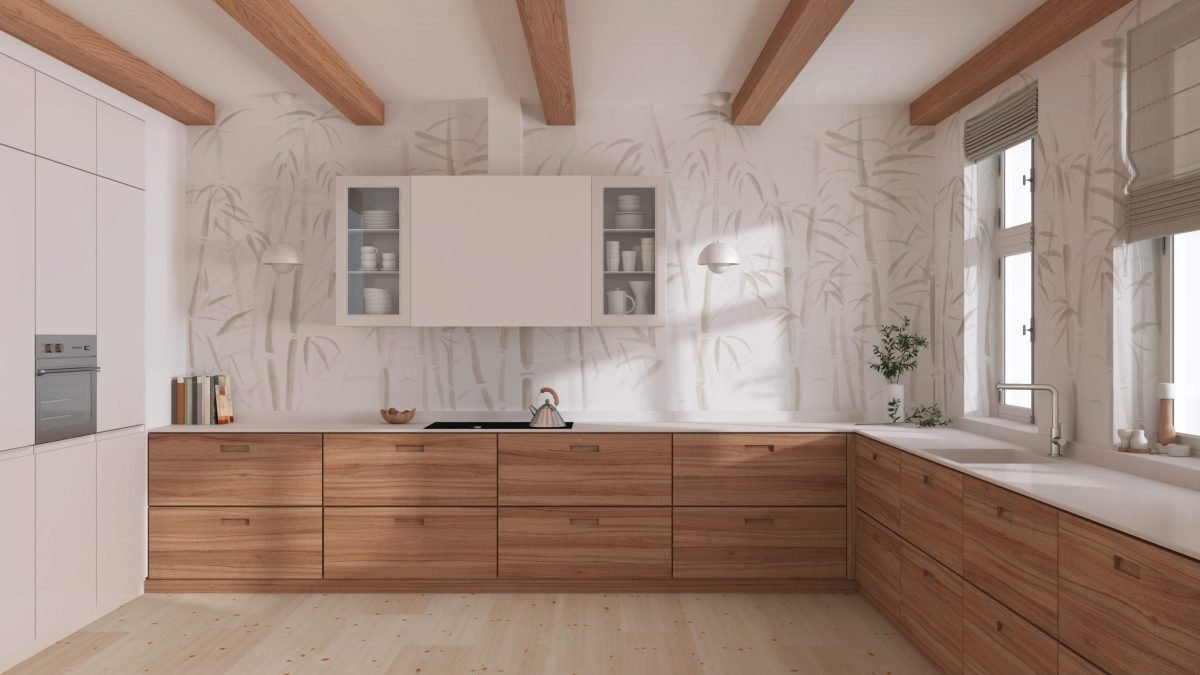
This bespoke Japandi kitchen by Ateliers Jacob showcases the extraordinary potential of custom cabinetry. Three flagship collections — Lacquer, Oak Wood, and voquente — are woven together to create a layered, enveloping visual harmony. A Laminam porcelain countertop in Pietra di Savoia Perla (a mineral-and-clay blend fired at extreme temperatures) reproduces the depth of raw stone without any toxic resins. The flush-door refrigerator, handle-free doors, and integrated hood maintain an atmosphere of pure, undisturbed calm.
Key Design Elements:
- Three-collection custom cabinetry blend (Lacquer, Oak, voquente)
- Laminam Pietra di Savoia Perla porcelain countertop
- Flush-door refrigerator and integrated hood
- Handle-free design for visual purity
8. 🌾 The Linje in Tusk & Bark — Earthy Tones & Handleless Design
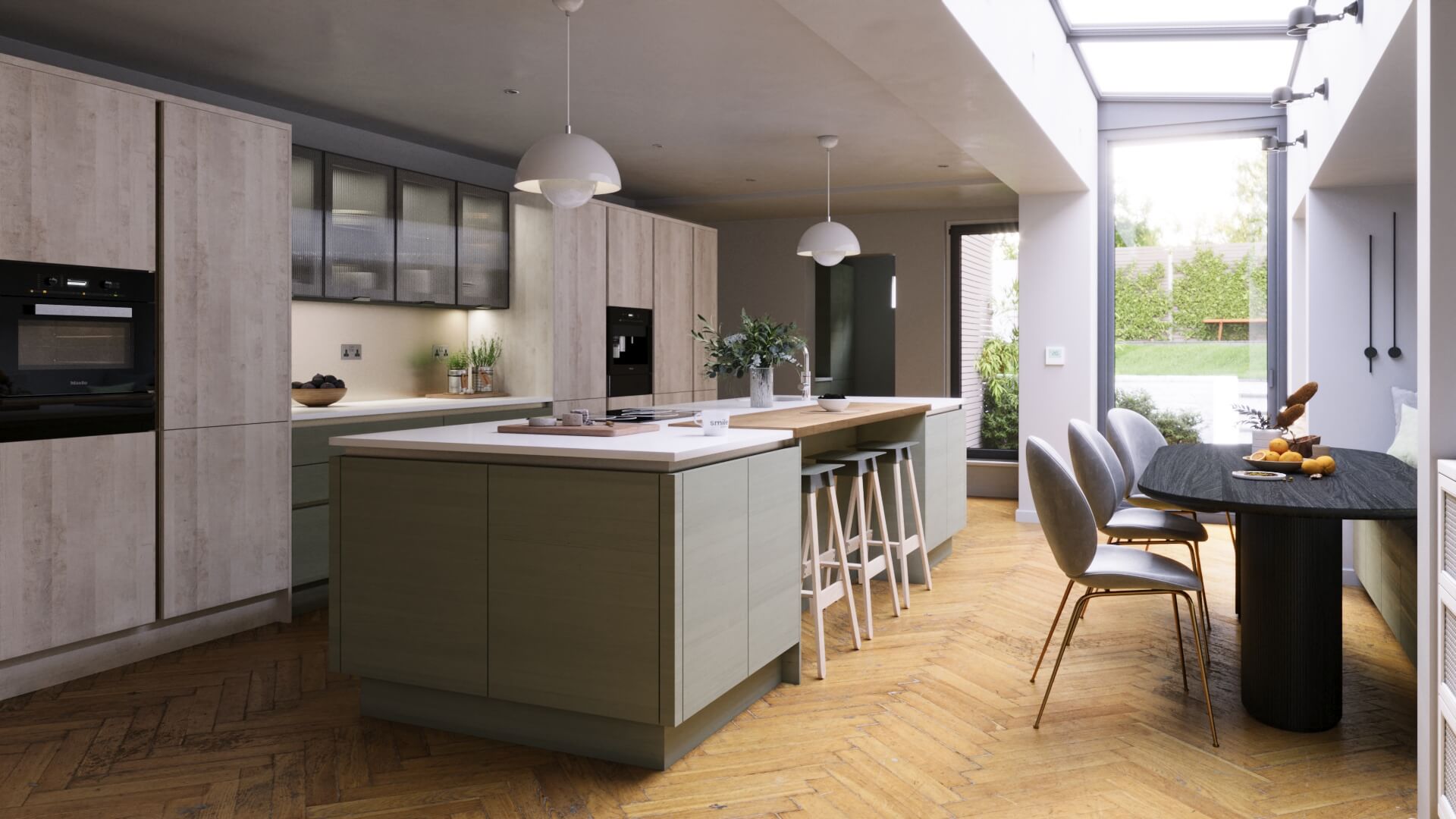
The Linje Kitchen by Smile Kitchens in Tusk (a warm beige) and Bark wood panels is a study in grounded Japandi warmth. The completely handleless design creates a seamless, streamlined surface that reads as calm and intentional. Bark wood panels on the island provide a soft, natural contrast against the muted beige cupboards. This kitchen demonstrates one of Japandi’s most powerful tools: layering shades from the same earthy family to create depth without discord.
Key Design Elements:
- Fully handleless kitchen in warm beige “Tusk”
- Bark wood panels for natural island contrast
- Earthy tonal layering for dimensional warmth
- Seamless, sleek silhouette throughout
9. 🪨 The Light Japandi Oak — Scandinavian Serenity

This Light Japandi Kitchen by Nordiska Kök leans fully into the Scandinavian soul of the style. Pale oak, generous natural light, and proportions carefully calibrated for calm come together in a kitchen that feels almost meditative. No drama, no excess — just space, light, and beautiful materials doing their job. The result is a kitchen you never want to leave, which is, of course, the entire point of Japandi.
Key Design Elements:
- Pale oak cabinetry for an airy, light atmosphere
- Emphasis on proportions and spatial flow
- Maximized natural daylight
- Timeless, calm and restrained material palette
🎨 The Japandi Kitchen Design Cheat Sheet
Here’s a quick-reference guide to nailing the style in your own home:
| Element | What to Choose |
|---|---|
| Cabinetry | Handleless, floor-to-ceiling, natural wood (oak, walnut) |
| Countertops | Quartz, marble, honed granite, porcelain, butcher block |
| Color Palette | White, beige, taupe, stone grey, charcoal, warm black |
| Accent Colors | Sage green, clay red, dusty rose, indigo |
| Materials | Wood, stone, ceramic, rattan, linen, bamboo, wool |
| Lighting | Pendant lamps (washi paper, brass, black metal), recessed lighting |
| Plants | Sculptural branches, vases with stems, potted houseplants |
| Storage | Integrated hidden storage, pull-out drawers, larder units |
| Accessories | Handmade ceramics, simple vases, minimal artwork |
Final Thoughts: Why Japandi Endures
Japandi isn’t just a trend — it’s a philosophy. At its core, it asks us to slow down, to value quality over quantity, and to surround ourselves with things that are both beautiful and useful. In the kitchen, this translates into spaces that are not only stunning to look at, but genuinely joyful to cook and live in.
Whether you gravitate toward the pale, airy end of the spectrum or prefer the moody, dark-oak drama of Japanese aesthetics, there is a Japandi kitchen out there with your name on it.


